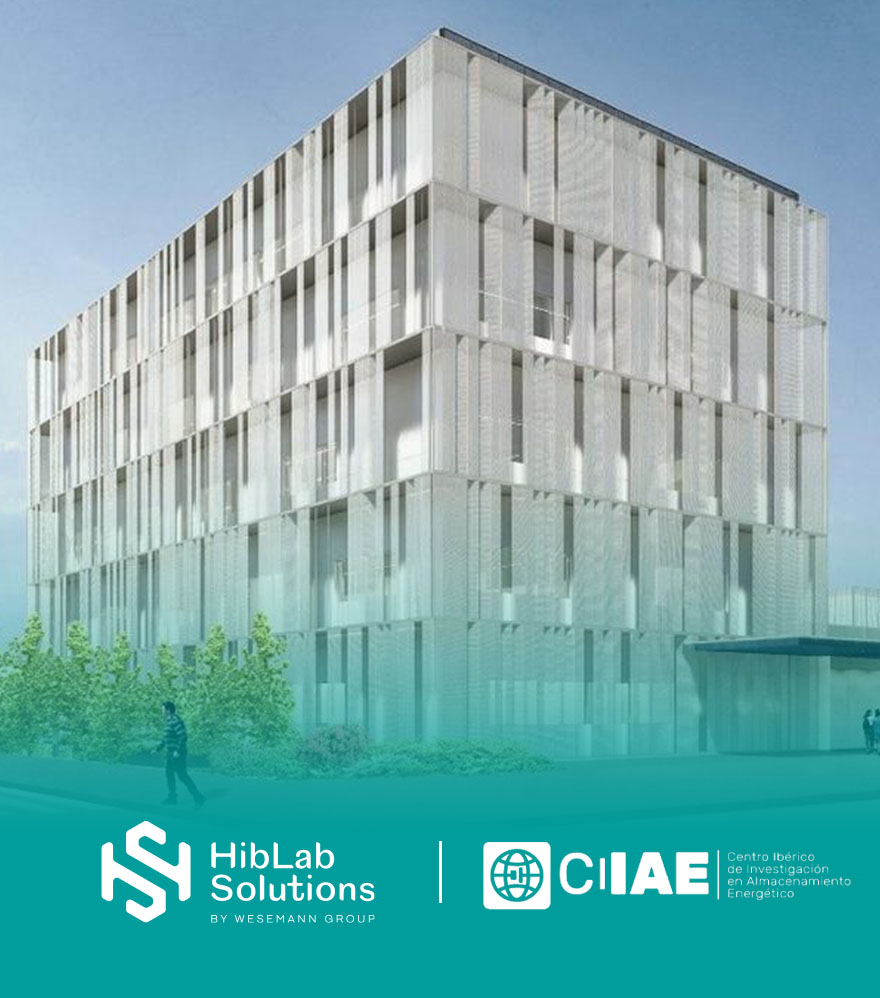
Strategic scientific infrastructures designed to evolve
A few years ago, our colleagues at Wesemann AG actively participated in the development of Lonza AG’s BSL-2 research center in the Stucki Science Park. A project of approximately 1,300 m² dedicated to advanced biotechnology research that, beyond its technical scope, represented something more significant: a way of understanding the laboratory as a strategic infrastructure. Today, in a context where biotechnology is accelerating again, it is worth recalling what made that project remain relevant.
The laboratory is not a space. It is a system.
In BSL-2 environments, the conversation doesn’t start with square meters or furniture. It starts with the processes! In Basel, the challenge was not only to meet biosafety standards. It was to create an environment capable of evolving without losing efficiency or safety. This involved working on clear separation of flows, early technical integration, coordination between architecture, engineering, and facilities, modular design with scalability in mind, and ergonomic and operational optimization of space.
A well-designed BSL-2 laboratory is not measured solely by its certification; it is measured by its ability to keep functioning as scientific projects evolve.
Comprehensive management as a differentiating factor
The project was developed under global coordination that integrated technical planning, execution supervision, and quality and timeline control. But the real differentiator was the holistic vision. When all disciplines work in alignment from the start (architecture, engineering, technical furniture, facilities, and scientific operations), the result is not simply a functional building. It is an innovation platform.
The relevance of the approach
Years have passed since that project at Lonza AG, but the principles that guided it remain fully relevant: real flexibility, safety integrated into the design, long-term thinking, and standardization without losing adaptability. Today, many international companies are reviewing or expanding their facilities in different countries, seeking technical consistency between locations and homogeneous quality standards. In this context, experience gained from international projects is not just a reputational asset—it is a methodological guarantee.
From international experience to the local context
At HibLab Solutions, we apply this same philosophy in the Spanish and LATAM markets:
- Process-oriented lab planning.
- Complete technical integration.
- Strategic management of complex projects.
- Alignment with international standards adapted to local regulatory frameworks.
The key is not to replicate a laboratory. It is to replicate a method because excellence in scientific infrastructures does not depend on the country—it depends on the approach.